A Canadian book blog: Publishing, marketing, books and technology from a Canadian perspective

Monday, September 20, 2010

Old Technology That I Explain to My University Class

I’m teaching Pub355: Online Marketing for Publishers at Simon Fraser University.

On Friday, I explained how university students in 1997 would have accessed magazine articles published prior to that year.
* go to the library
* search the internal system or the card catalogue to find the shelf reference number (if there was a physical copy available) otherwise go to the special librarian to get the microfiche
* schedule time to use the microfiche reader

Microfiche: Microfiche is a card-shaped piece of photographic film, usually 4x6 or 3x5 inches in size, used for the storage of miniaturized text in a grid pattern. It can be read only with the aid of magnification by use of a microfiche reader. Microfiche may contain a printed book, journal, or newspaper. (Source: lib.uwo.ca)
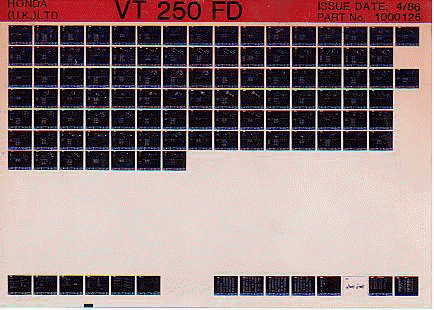
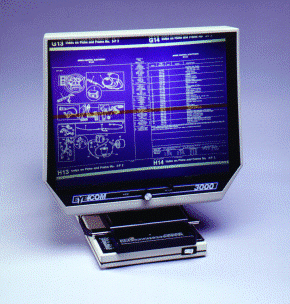
image
image

How fun does that look?

What ancient technology can I explain this week? Maybe the dictaphone (which is a word my spell check does not recognize).

Dictaphone Parcel from Lauri Warsta on Vimeo.


This is a fiche reader, but archived magazines were of course also available on film rolls that you could browse through with a magnifier like the fun one above, only with a variable-speed forward and reverse switch.

The magazine pages would zoom by, from right to left, as you worked your way through the film searching for a specific date. After some fine-adjusting of scale and position, a dime in a slot would then produce a photocopy of the page. I imagine it is still the only way to read magazines from the 1940s-1960s era…?

I once spent much of a summer camped in front of those infernal machines. I needed to pop Gravol to counteract the nausea.

But I hear microfiche will be around for longer than our fancy pants computer databases.

James, I remember viewing newspapers on microfilm and turning that knob back and forth. It was nauseating.

Since the spell check knew microfiche but not dictaphone, I suspect that microfiche will be around for awhile. Once it disappears from spell check, I’ll know it’s on the way out.

I wonder how many people know how manual layup used to work? And that cut and paste literally meant cutting the text from the typesetting machine and pasting it into a layout. Even back in the day it wasn’t well known.

Interestingly, lots of questions have been coming in at the library reference desk this week about old technology - students in a history of comm studies course are looking for tidbits on player pianos, jukeboxes and eight-track tapes (among other “dead” technology)

I vote for you to explain the telex machine grin

Telex! Why don’t I tell them about IBM punch cards while I’m at it.

Commenting is not available in this weblog entry.