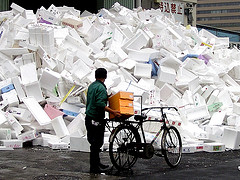
 Let’s take out the trash.
1. Reveries.com has a post on trash-bin, book scavengers. These are men (and some women) in Manhattan, who eke out a living by sifting through trash bins looking for books that people have discarded.
2. Fast Company has an article in the February magazine, “Is the Tipping Point Toast?”, which is stirring up the internet marketing industry. The article positions Duncan Watts against Malcolm Gladwell.
Watts posits that marketers spending billions of dollars a year targeting influentials are wasting their money. Gladwell, in The Tipping Point, postulates that trends are established when connectors and mavens come into contact with ideas that can be easily disseminated.
It’s a good article, but I don’t understand what the fuss is about.
I agree with Watts that Gladwell’s Tipping Point taps into the ego of advertisers/marketers–the ego that allows them to believe that if only they can get the cool kids to like their product then the rest of the world will follow. But that’s not the full argument Gladwell is making.
The article positions these two as opposing forces, but I think there is logic to both arguments.
If someone (who I trust) tells me about something (that I’m interested in), I am likely to follow their advice, buy the product they are suggesting, think positively about a service, etc. If I have a first hand experience that is positive, then I am likely to promote that service or product.
Both the Gladwell hypothesis and the Watts hypothesis are flawed because they don’t look closely enough at these two key ingredients: trusted source, something of interest to me.
I don’t have fancy computer models like Watts or well-known brand stories like Gladwell, but here’s my small anecdote.
Darren Barefoot was doing some work for Brother Printers. Brother had a new line of printers it was interested in promoting and they wanted some bloggers to test the printers.
I had a good time test driving the HL-4070CDW.
In internet land, my blog post is a very small blip in the Brother Printer landscape. Although SoMisguided is the first result for the search “brother printer wireless”. But down on Earth, everyone who comes into our office comments on our fancy printer and I mention it’s a Brother Printer and that I like it very much. It does an excellent print job. I also comment that I wish it did more. There are multi-function centres that print, scan, fax, do the dishes and photocopy. Ok, no dishes. I have even gone to Future Shop to check out the other models, and I had a conversation with the sales guy, who provided favourable feedback on the Brother line in comparison to other brands. Since then I have recommended Brother Printers to 2 friends who were looking for new printers. Both bought Brothers. (There’s some fun alliteration.)
So was it a waste of money for Brother Printers to hire Darren and to get a bunch of bloggers test driving their printers? I don’t think so.
Again, it comes down to trusted sources and timely feedback on something people were interested in.